
2026 – The Retreat’s Three-Year Harvard Study
Abstract
This report summarizes findings from a three-year evaluation of The Retreat’s adult residential recovery program.
The study followed 206 adult guests from program entry through their stay and for 12 months afterward. Assessments measured alcohol and other drug use, remission, quality of life, psychological well-being, employment, recovery support engagement, and other indicators of functioning.
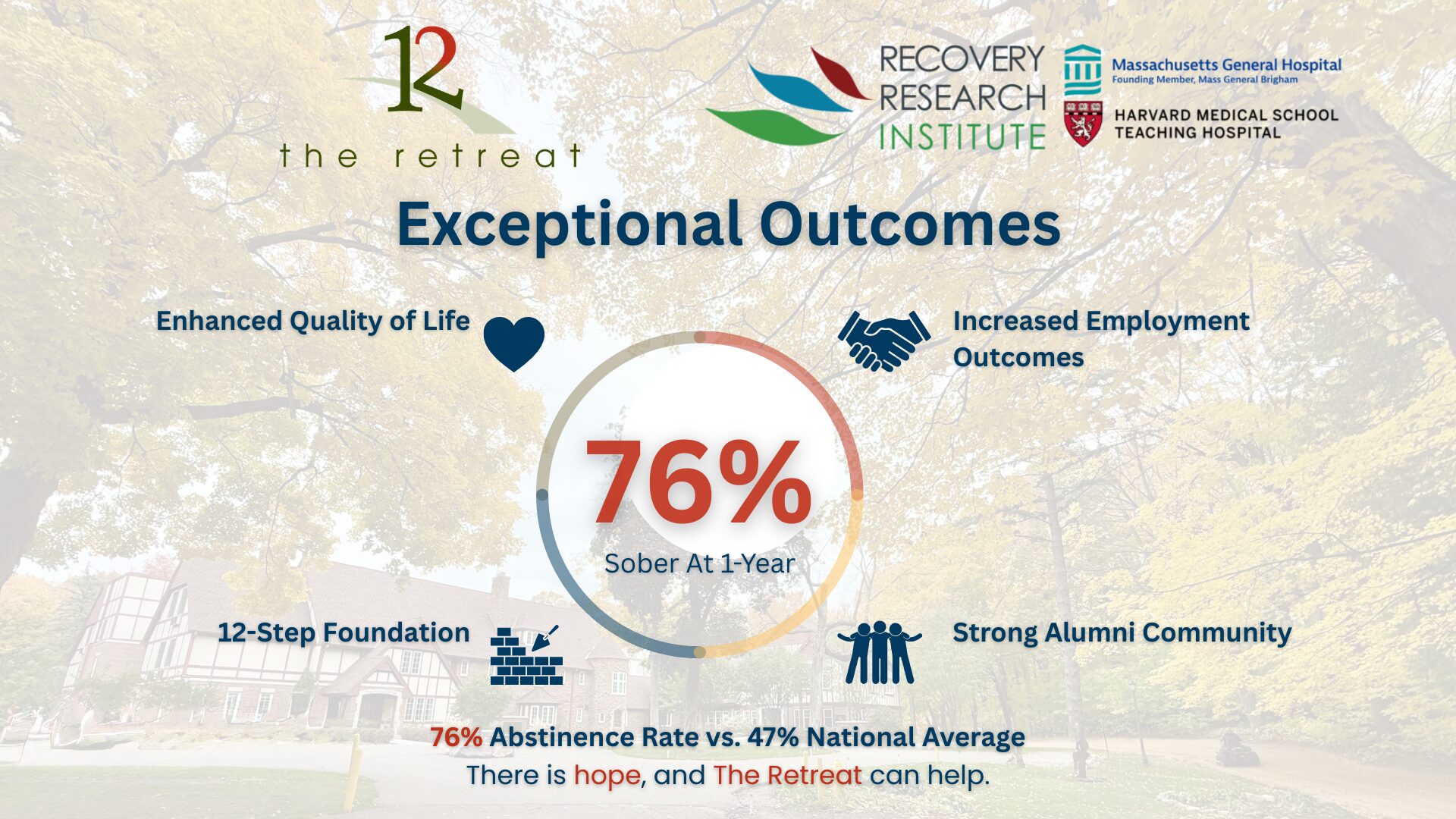
At the 12-month follow-up, complete abstinence from alcohol had increased from 4.37% at program entry to 76.07% among participants assessed. Average days abstinent from alcohol increased from 50.70% at baseline to 96.89% at 12 months.
The evaluation was conducted by the Recovery Research Institute at Massachusetts General Hospital and Harvard Medical School, with Dr. John Kelly, founder and director of the Recovery Research Institute.
Study Design
Participants entered the study between March 23, 2023, and October 2, 2024. Each participant completed assessments at program entry, during the stay, at departure, and at three, six, and 12 months.
The study used a longitudinal, naturalistic design. All eligible Retreat participants could take part. No exclusion criteria were applied.
What the Study Found
Complete Alcohol Abstinence
The percentage of participants reporting 100% abstinence from alcohol increased from 4.37% at program entry to 76.07% at the 12-month follow-up.
Fewer Alcohol-Related Problems
Average days abstinent increased substantially. Drinks per day, heavy drinking days, and alcohol- and drug-related consequences decreased over the follow-up period.
Increased Remission
The percentage of participants classified as being in remission increased from 3.40% at baseline to 82.76% at 12 months.
Improvements in Quality of Life
Participants reported improvements in quality of life, happiness, life satisfaction, self-esteem, emotional support, and psychological well-being.
Employment and Recovery Support
Employment increased during the follow-up period. Participation in A.A. and other mutual-help groups rose after The Retreat experience and remained strong at 12 months.
Many participants also made greater use of sober living and other continuing recovery supports.
Comparison Context
The Retreat’s 12-month result may be viewed alongside a 47% average across 276 treatment follow-up studies. This comparison is provided as context. The studies used different populations, measures, and follow-up methods.
Outcome Study Detail
| Participants | 206 adult guests |
|---|---|
| Program studied | The Retreat’s residential recovery program |
| Study period | March 2023 through October 2024 enrollment |
| Follow-up | Three, six, and 12 months |
| Primary alcohol finding | 76.07% reported complete alcohol abstinence at 12 months |
| Average alcohol abstinent days | 96.89% at 12 months |
| Remission | 82.76% at 12 months |
| Research partner | Recovery Research Institute at Massachusetts General Hospital and Harvard Medical School |
How to Read These Findings
This was a single-group evaluation without a control group. Because of that, the findings cannot prove that every improvement was caused by The Retreat alone. Follow-up attrition and reliance on self-report also limit interpretation.
The results are encouraging evidence of substantial improvement across alcohol and other drug use, quality of life, functioning, and recovery support engagement. They do not guarantee a particular outcome for every guest.
Recovery is personal. Recovery happens in community.
Outcome Study Detail
Research partner: Recovery Research Institute at Massachusetts General Hospital and Harvard Medical School.
Enrollment period: March 2023 through October 2024.
Participants: 206 adult guests in The Retreat’s residential recovery program.
Follow-up period: 12 months.